News & insights
Content Writing for SEO: How to Sound Human and Still Rank

Content Writing for SEO: How to Sound Human and Still Rank
Content writing for SEO works best when the page sounds like it was written for a real person first. The search engine part still matters, but the writing has to answer an actual question, not just repeat a keyword until it loses all meaning.
That is the part many businesses get wrong. They either write something stiff and over-optimised, or they write something warm and useful that never gives search engines enough to work with. The better answer sits in the middle.
You want content that reads naturally, explains the topic clearly, and gives the reader a sensible next step. If it does that, it is far more likely to help rankings and enquiries at the same time.
Content writing for SEO starts with one reader problem
Every useful page should solve one clear problem. Not three. Not seven. One.
When the page has a single job, the writing gets easier. The title can stay focused. The opening paragraph can get to the point faster. The headings can support the same idea instead of wandering off into side quests.
That is also how you avoid the “this sounds like a blog post about marketing by someone who has never spoken to a customer” problem. Real readers do not want a lecture. They want a useful answer.
For service businesses, that usually means the page should help someone choose, compare, understand, or act. If the content does not help with one of those, it probably needs a rethink.
What Google is actually looking for
Google says it wants helpful, reliable, people-first content. That is not a secret code. It is a direct reminder that the content should be useful to the person reading it, not just technically stuffed with the right terms.
The helpful, reliable, people-first content guidance is the clearest version of that idea. Google’s SEO Starter Guide says much the same thing in a more practical format: make pages easy to understand, useful to users, and easy to crawl.
That does not mean every page needs to sound academic or polished to the point of boredom. It means the page should be clear, specific and useful. A good page answers the question quickly, then gives enough detail to build trust.
If you want to improve the chances of a result being clicked, Google’s meta description guidance is also worth a look. A good title and snippet do not rescue bad content, but they do help the right people choose your page in the first place.
How to write content that sounds human
The best SEO content usually sounds plain, not polished. Plain does not mean dull. It means the reader does not have to fight through marketing language to understand the point.
There are a few habits that help:
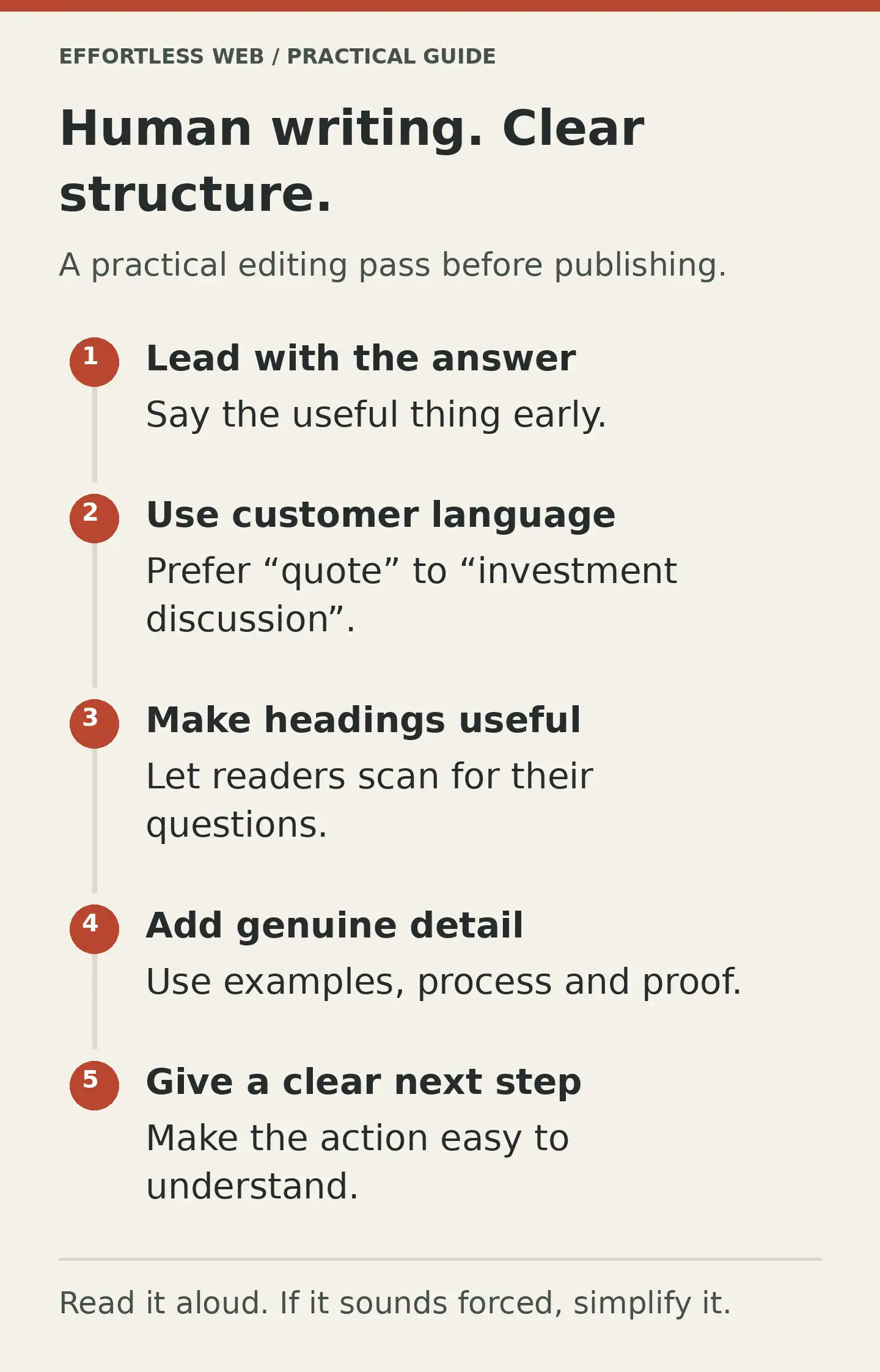
- Say the thing early. Do not make the reader wait three paragraphs before you explain what the page is about.
- Use the words customers use. If people say “quote”, do not keep calling it an “investment discussion”.
- Break up the copy with useful headings. Headings should tell the story of the page, not just decorate it.
- Include real detail. Specific examples, steps, and outcomes make a page feel grounded.
- Keep the rhythm natural. Mix short sentences with longer ones. Do not make every paragraph sound like a press release.
That last point matters more than most people think. A page can be technically correct and still feel fake if every sentence has the same shape. Humans do not write like templates. Your content should not either.
What makes content sound robotic
The warning signs are usually easy to spot once you know what to look for.
It sounds robotic when it repeats the same keyword in every paragraph. It sounds robotic when it opens with a generic line like “in today’s fast-paced digital world”. It sounds robotic when it says a lot without actually saying anything useful.
It also sounds robotic when the page is trying too hard to be neutral. Strong content does not need to shout, but it does need a point of view. A service business article should be willing to say what matters, what does not, and what the reader should do next.
That is a better use of the page than trying to sound clever.
Structure matters more than people think
Good structure helps both readers and search engines. A clear H1, clean H2s, and a sensible flow keep the page easy to scan. They also help the topic land faster.
That is where on-page SEO and writing meet. If the structure is weak, even good copy can feel messy. If the structure is strong, the content feels more confident straight away.
For Effortless Web, that means content writing should usually connect with SEO & Content Marketing, Content Writing, and On-Page & Technical SEO. Those pages work together because good writing needs a clear strategy, not just a decent paragraph or two.
A related article that fits here is How to Choose Blog Topics That Support SEO and Sales at the Same Time. Topic choice is often where the whole thing starts to go right or wrong.
A simple checklist before you publish
Before you hit publish, ask yourself a few blunt questions:
- Would a customer understand this page in the first minute?
- Does the first paragraph say what the page is about?
- Is the topic narrow enough to be useful?
- Are the headings doing real work?
- Have you used enough proof, detail, or examples?
- Is the CTA clear?
- Does the copy sound like a person rather than a template?
If the answer is no to most of those, the page probably needs another pass. That is normal. Good content usually improves when you cut the fluff and let the useful parts breathe.
Why this matters for service businesses
Service businesses do not need content for the sake of content. They need pages that help the right people choose them.
That means the writing has to do two jobs at once. It needs to be readable enough for a human, and structured enough for search. If one of those fails, the page is weaker than it needs to be.
The businesses that get this right usually end up with fewer but better pages. That is often a good trade. A smaller set of pages that are actually useful will usually outperform a larger pile of thin ones.
Need help with content writing for SEO that sounds human and still ranks?
If you want content that is clearer, more useful and better aligned with search intent, talk to Effortless Web about Content Writing, SEO & Content Marketing or get in touch.