News & insights
How to Create Location-Relevant Content Without Sounding Spammy

How to Create Location-Relevant Content Without Sounding Spammy
Location-relevant content helps service businesses show up for nearby customers without stuffing city names into every paragraph. The goal is simple: make it obvious that you really serve the area, and make the page useful enough that a real person would want to keep reading.
If the page only swaps in suburb names and repeats the same lines, it starts to look like a doorway page instead of a genuinely helpful local page.
Location-relevant content should feel specific to a real customer
The best local content does not read like a list of place names. It reads like something written for the people in that area, with their situation, questions, and buying concerns in mind.
That might mean mentioning the kinds of customers you help, the service conditions in that area, the way people usually find you, or the practical details that matter locally. A dental clinic, a mechanic, a therapist, and a home-service business will all need different kinds of local context.
The important part is that the local signal is real. A page should answer the question: why does this page exist for this location?
Use local context, not keyword repetition
There is a big difference between local relevance and local stuffing.
Local relevance adds useful detail. It might include the service area, nearby landmarks, local conditions, common customer problems, travel considerations, or proof that the business has done work in the region. Keyword stuffing just repeats the place name until the page feels mechanical.
In practice, a better local page usually includes:
- a clear description of the service
- the area or areas served
- examples or proof from that region
- FAQs that match local buyer concerns
- contact details and next steps
That is enough for search engines to understand the topic without making the copy sound like it was assembled by a spreadsheet.
What Google is trying to avoid with spam policies
Google’s spam policies are a good reminder that location pages should not exist just to capture search terms and push users somewhere else. The problem is not mentioning places. The problem is making pages whose only job is to look relevant without being genuinely useful.
The doorway-pages guidance is especially relevant here. It flags patterns like multiple pages targeted at specific regions that funnel users to the same destination, or pages made to maximize reach without adding real value. That is the line you do not want to cross.
If a page would feel useless once the city name is removed, it probably needs more substance.
Give each location page its own reason to exist
One of the cleanest ways to avoid spammy local content is to make each page meaningfully different.
That does not mean writing a completely new business model for every suburb. It does mean giving each page a real angle. For example, one location page might emphasise emergency response times, another might focus on multi-site support, and another might highlight a particular service mix that is common in that area.
Useful differences can come from:
- local customer types
- service-specific needs in that area
- proof from nearby projects
- different FAQs or objections
- location-specific calls to action
That is the difference between a page that helps someone choose and a page that just repeats the same template with a new suburb inserted.
Location-relevant content works best when the business is actually local enough
This sounds obvious, but it matters.
If you do not genuinely serve an area, a page about that area is hard to justify. If you do serve it, the page should reflect the real service relationship, not pretend you have a physical footprint you do not have.
Google’s Localized Versions of your Pages guidance is useful when you are thinking about different regional audiences, because it keeps the focus on telling Google which version fits which user best.
For service businesses, that means the page should help users by language, region, and context — not just by reusing the same content with a place name swap.
Connect local pages to the rest of the site
Local pages should not sit on their own like isolated landing pages. They should connect to your service pages, content pages, and proof pages.
For Effortless Web, that usually means linking local pages to Local SEO and SEO & Content Marketing. If the page needs stronger copy support, Content Writing can also be a useful tie-in.
A related article that fits well here is Local SEO for Australian Service Businesses: Where to Start in 2026. That post covers the broader local-search setup, while this one focuses on how to make local content sound natural.
Internal links help the page feel like part of a real site, not a pile of isolated local experiments.
Use structured data and business details to back up the page
Strong local content should be matched by consistent business details. If the page claims a location, the rest of the site should support that claim.
Google’s Local Business structured data documentation is one signal that business details matter. It also reinforces the value of making your location, contact and service information easy to interpret.
This is not about turning a page into a schema dump. It is about making the business easier to verify. That includes clear contact information, consistent naming, and content that reflects the real service area.
A simple test before you publish
Before you publish a location page, ask these questions:
- Would this page still make sense if the suburb name was removed?
- Does it explain why this area matters to the business?
- Is there any real proof or example from the location?
- Does the page help a local buyer make a decision?
- Would it feel repetitive if every location page said the same thing?
- Does the page link naturally to the relevant service page?
If the answer to most of those is yes, you are probably in a good place.
If not, the page may need more context, more proof, or a better reason to exist.
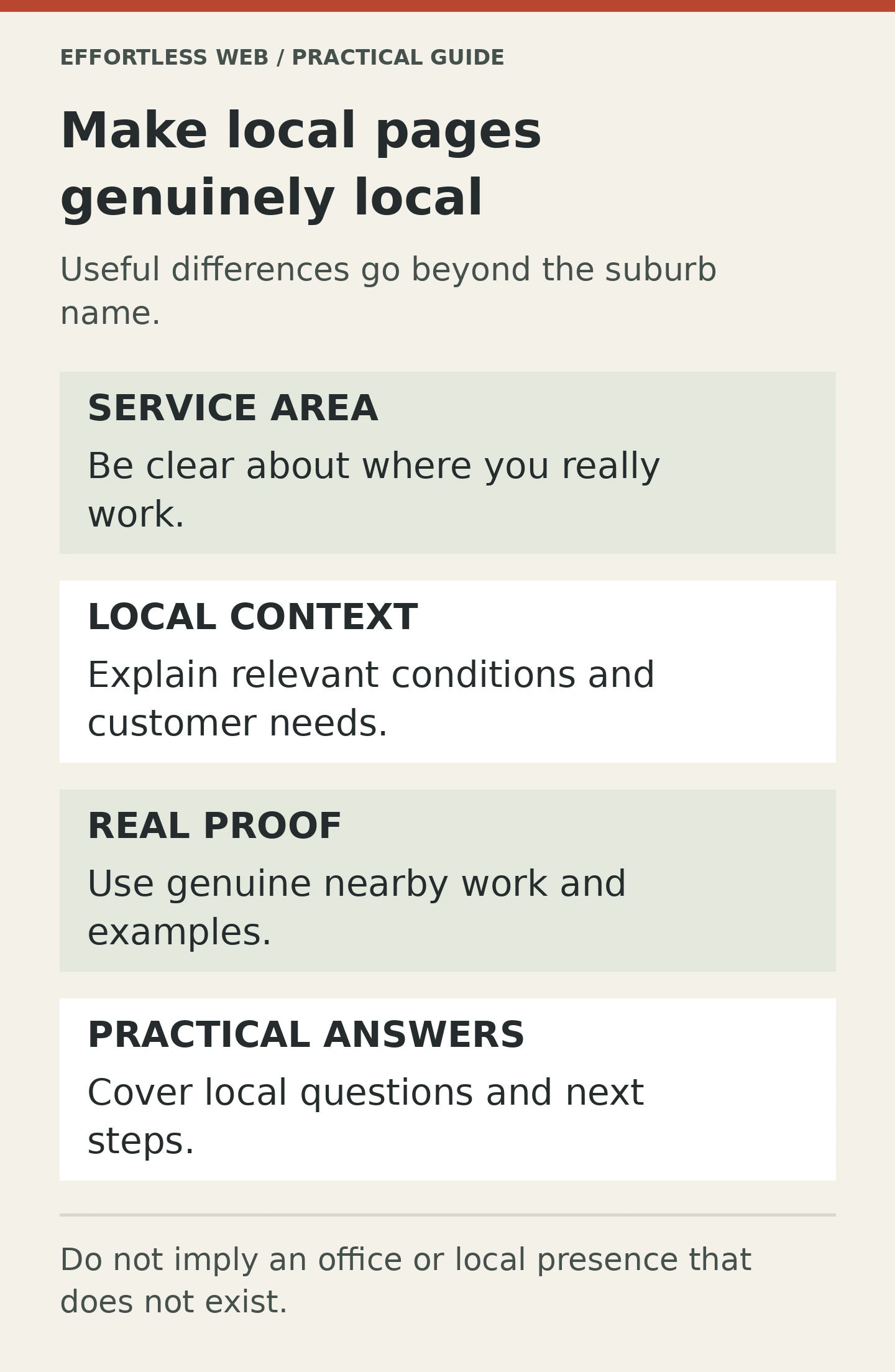
Location-relevant content should help people, not just search engines
The most useful local pages are the ones that feel natural to a customer in that area. They are clear, specific, and grounded in the actual service being offered.
That makes them better for search, but it also makes them better for sales. A page that sounds human is usually easier to trust. A page that sounds trust-worthy is usually easier to contact.
That is the real goal.
Need location pages that feel local without sounding robotic?
If you want help with local content, structure and the SEO strategy behind it, talk to Effortless Web about Local SEO, SEO & Content Marketing or get in touch.