News & insights
On-Page SEO Basics for Service Businesses That Want Better Rankings

On-Page SEO Basics for Service Businesses That Want Better Rankings
On-page SEO basics for service businesses are mostly about making each page easy for the right person — and Google — to understand. That means clear page titles, useful headings, relevant copy, sensible internal links, and a page that actually answers the search.
If your website only looks good but does not clearly explain the service, on-page SEO will not do much. The job is to line up the page with the query and the business outcome.
On-page SEO basics start with one clear page purpose
The easiest way to weaken a page is to try to make it do too much. A service page should have one main job. A blog post should have one main job. A location page should have one main job.
When that purpose is clear, the rest of the on-page work becomes simpler. The title can match the page. The headings can support the page. The copy can answer the same question from a few different angles without drifting off-topic.
Google’s SEO Starter Guide is a good reminder that the basics still matter: make pages useful, make them understandable, and make it easy for search engines to crawl and index them.
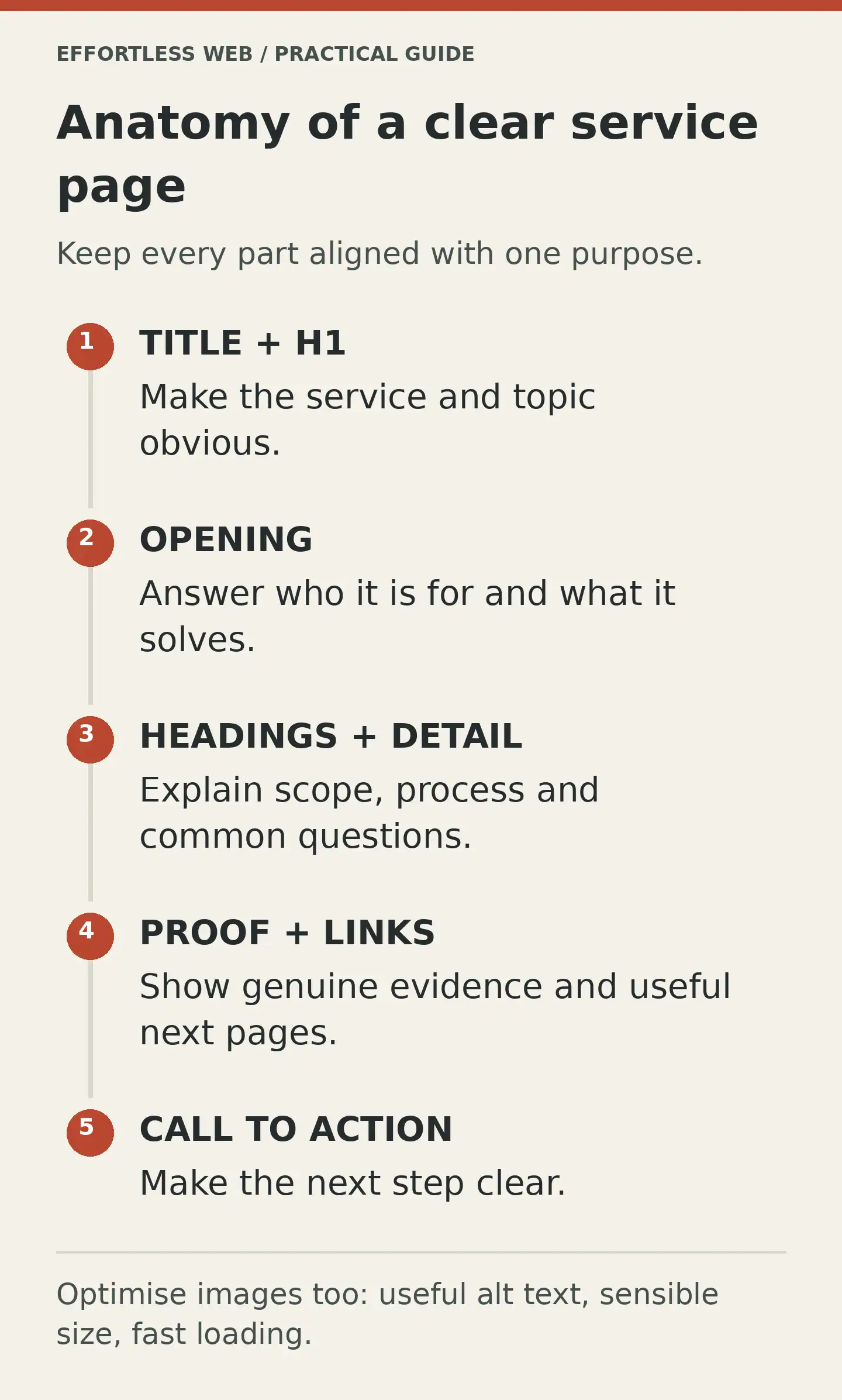
Get the title, H1 and opening copy working together
If on-page SEO has one habit that gets ignored, it is this: the page title, H1, and opening paragraph should all say roughly the same thing in slightly different ways.
That does not mean repeating the exact same sentence three times. It means making the topic obvious from the start. If the page is about a service, say the service. If it is about a problem, say the problem. If it is about a location, say the location in a natural way.
Google’s guidance on Influencing Title Links in Google Search explains that title links are generated from both the title element and other page headings. That is a useful reminder that your page structure affects how the result may appear.
The practical takeaway is simple: write a title that is unique, clear, and useful. Then make sure the first paragraph confirms the same topic without turning into keyword spam.
Use headings to make the page easy to scan
Headings are not there just to break up text. They help readers understand the shape of the page.
That matters because most visitors do not read from top to bottom. They skim first, then decide whether to stay. Clear H2s and H3s help them do that quickly. They also help search engines understand what each section is about.
A strong heading structure usually does three things well:
- it confirms the page topic
- it breaks the page into logical sections
- it makes it easy to jump to the part that matters most
If every heading sounds clever but says very little, the page becomes harder to use. Plain language is usually better than decorative language here.
Write for intent, not just keywords
Keywords matter, but they are not the whole job.
On-page SEO works best when the page answers the kind of question the searcher actually has. A service business visitor might want to compare options, understand a process, check pricing signals, or work out whether the business is a fit. The page should respond to that intent, not just mention a keyword a few times.
This is where useful detail matters: the service scope, the audience, the benefits, the process, the proof, and the next step. If the page is thin on those things, it is harder to rank well and harder to convert the traffic if it does arrive.
Google’s helpful content guidance makes the same point from another angle: write for people first, and make the page genuinely useful.
Strengthen the page with internal links and supporting content
Internal links are one of the most practical parts of on-page SEO because they help users and search engines move through the site.
For Effortless Web, a service page about on-page optimisation should usually connect to SEO & Content Marketing and On-Page & Technical SEO. Those links give the page a clearer place in the site architecture and help the visitor understand what else is available.
A related article can also help if it is genuinely relevant. A strong companion piece is How to Choose Blog Topics That Support SEO and Sales at the Same Time, because topic choice and on-page structure are closely connected.
The point is not to stuff the page with links. The point is to create a useful trail for a person who wants to keep going.
Do not ignore images, file names and page experience
Images can support a page, but they should not slow it down or distract from the message.
Use them where they help explain a process, show proof, or make the page easier to understand. Give them descriptive alt text. Keep file names sensible. Avoid huge image files that make the page sluggish on mobile.
Google’s page experience documentation is useful here because it reinforces a simple idea: the page has to feel usable, not just look fine in a mockup.
If a page is technically “optimised” but slow, jumpy, or confusing, the visitor still feels that friction. On-page SEO should reduce friction, not add another layer of it.
A simple on-page SEO checklist for service pages
Before you publish or refresh a page, check the basics:
- Does the page have one clear purpose?
- Does the title describe the page accurately?
- Does the H1 confirm the same topic?
- Do the first two paragraphs explain what the page is about?
- Are the headings easy to scan?
- Does the page answer the main customer question?
- Are there internal links to relevant service pages?
- Is there a clear CTA near the end?
- Do the images support the page instead of slowing it down?
- Would a real customer say this page feels useful?
If the answer is yes to most of those, the page is in much better shape than most service-business pages out there.
On-page SEO basics are really about clarity
That is the part many businesses miss. On-page SEO is often treated like a technical trick when it is really a clarity exercise.
Clear pages rank better because they are easier to understand. Clear pages convert better because visitors do not have to guess what the business does. Clear pages also make the rest of your marketing work harder, because they give people somewhere solid to land.
So if you are starting from scratch, do not begin with gimmicks. Begin with the page structure, the page purpose, and the language real customers would use.
That is the foundation that makes everything else worth doing.
Need help with on-page SEO that supports rankings and enquiries?
If you want help tightening your page structure, titles, internal links and content, talk to Effortless Web about SEO & Content Marketing or get in touch.