News & insights
The Simplest Follow-Up Funnel for Missed Leads and Quote Requests
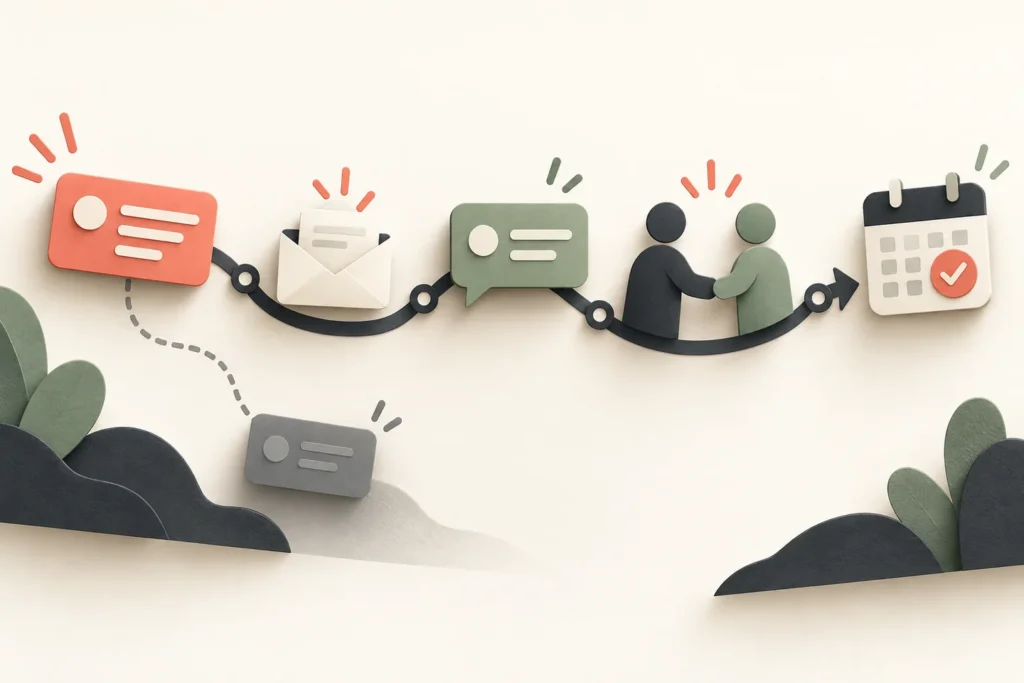
The Simplest Follow-Up Funnel for Missed Leads and Quote Requests
The simplest follow-up funnel for missed leads and quote requests does three things well: it responds fast, keeps the message short, and hands the lead to a human before interest disappears. That is all most service businesses need. Not a monster CRM build. Not a 14-step automation maze. Just a system that catches people while they still care.
The good news is that this is fixable. Most lost leads are not lost because the offer was bad. They are lost because the business replied too slowly, followed up awkwardly, or never built a clear next step after the first enquiry.
The simplest follow-up funnel for missed leads and quote requests
The easiest version of this funnel has four steps:
- Instant acknowledgement when the enquiry lands.
- A short follow-up sequence that answers the obvious questions.
- A human handoff when the lead is ready for a real conversation.
- A close-out or re-engagement step if the lead goes quiet.
That is enough to rescue a surprising number of missed leads. It also gives your team a clean process to follow instead of leaving everyone to improvise when the inbox gets busy.
If you want the channel choice behind the funnel, read When Should a Service Business Use Email, SMS, or Both? first. This article focuses on the sequence.
What happens in the first 10 minutes matters
Lead response time is not a nice-to-have. It changes the odds. HubSpot has repeatedly pointed to research showing that businesses respond far too slowly, and that the first few minutes are where the real advantage sits. Once the lead has moved on, you are not just following up a form. You are trying to re-open attention that has already drifted elsewhere.
That is why the first message should be automatic. The customer should never wonder whether the form worked. The instant response can be simple: thanks for reaching out, here is what happens next, and here is when they can expect a real reply.
If the enquiry is high intent, the second step should be even shorter. A fast human reply beats a perfect reply that arrives too late. In many service businesses, the person who responds first still gets the conversation.
What the first message should say
Keep it plain. Do not write a marketing essay inside the confirmation email. The first reply should do three things:
- confirm the enquiry was received,
- set an expectation for response time,
- give the lead one clear next step.
For example, a quote request might get an email that says the team has received the form and will reply by the end of the day. If the job is urgent, a short SMS can follow with a direct question or a booking link. If the lead does not respond, the next message should not repeat the same line forever. It should answer the most likely objection or offer a smaller next step.
This is where Automated Email Funnels become genuinely useful. The point is not to send more messages. The point is to make the first response useful enough that the lead stays in the process.
A simple funnel you can set up without overthinking it
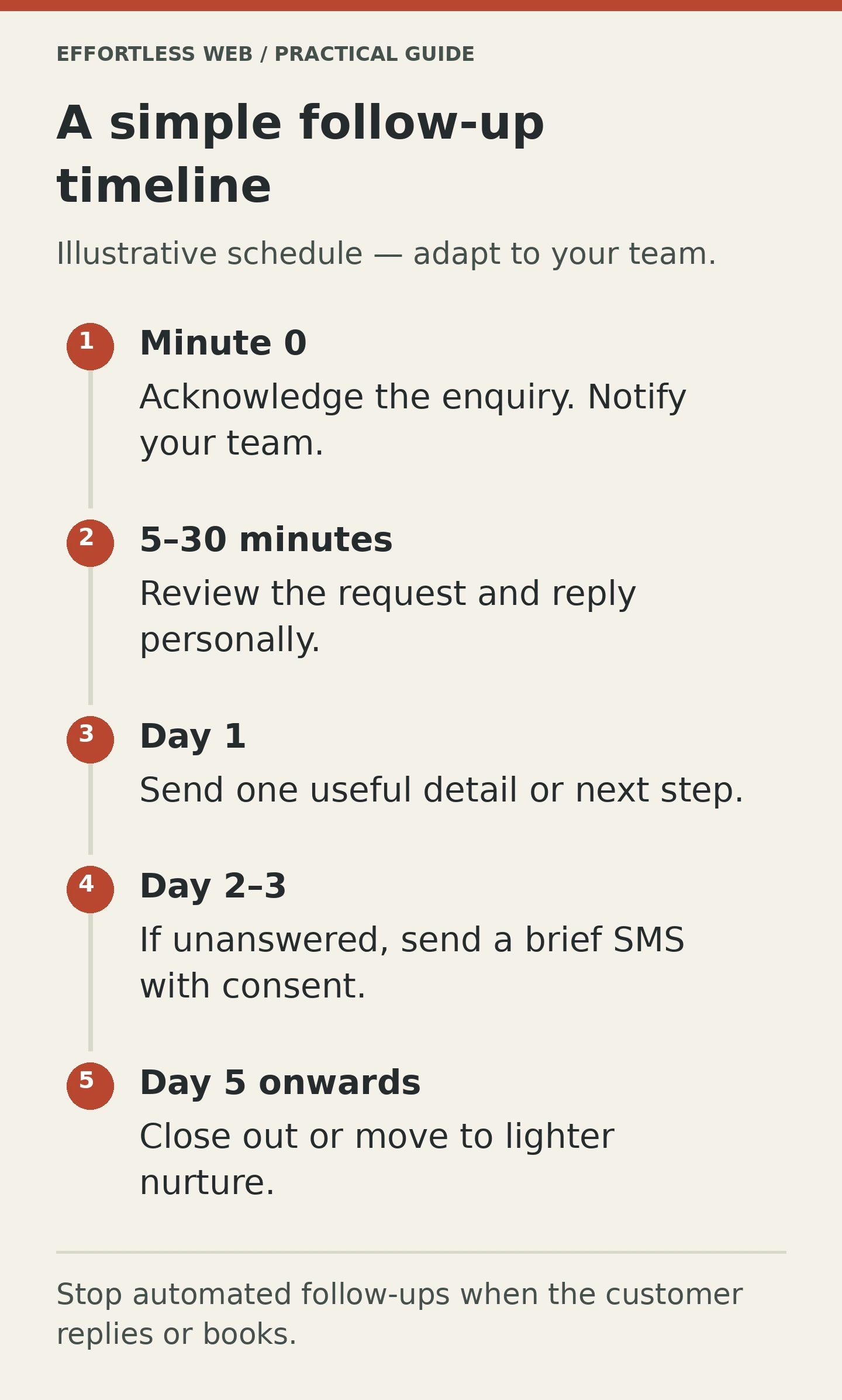
Here is a straightforward version that works for most service businesses:
- Minute 0: automatic thank-you email and internal notification.
- Minute 5 to 30: a staff member checks the lead and replies if needed.
- Day 1: a short follow-up email with one useful detail, such as pricing context, availability, or a link to a relevant service page.
- Day 2 or 3: one SMS reminder if the lead has not replied and consent is in place.
- Day 5 and beyond: move the lead into a lighter nurture sequence or mark it closed.
That is enough structure to stop most leaks. It is also simple enough that your team will actually use it, which is the part many businesses miss.
Where automation should stop
Automation should handle the repeatable parts. It should not replace judgment.
Stop the sequence when the lead replies, books in, asks for a custom quote, or starts a longer conversation. Stop it when the message needs a human decision. Stop it when the lead is high value and a personalised response is more important than another automated nudge.
That is also why the funnel should sit inside a broader customer retention setup. A good system does not just catch the lead. It decides when to hand the lead to a person and when to step back.
That broader setup sits naturally inside Email & Customer Retention Marketing, with SMS (Text) Marketing used where speed or reminders matter.
What to track so you know it is working
You do not need a giant dashboard. Track a few basic numbers instead:
- average response time,
- reply rate after the first follow-up,
- quote-to-booking rate,
- no-show recovery rate,
- leads that go cold after the first contact.
If those numbers improve, the funnel is doing its job. If they do not, the problem is usually one of three things: the first message is too vague, the follow-up is too slow, or the handoff to a human is too clumsy.
That is the real value of a simple funnel. It gives you a way to see where the leak is instead of guessing.
Why this works so well for service businesses
Most service businesses do not need a cleverer sales speech. They need a faster and cleaner response system. A good funnel reduces the time between “I’m interested” and “here’s what happens next.” That gap is where a lot of revenue goes missing.
HubSpot’s lead response guidance and Outreach’s trigger automation best practices point in the same direction: speed matters, triggers matter, and follow-up should be designed instead of improvised. Once that is in place, the rest of the system becomes easier to manage.
If you want the funnel to sit inside a wider lead recovery and nurture setup, the right starting point is usually the automation itself, not another ad campaign.
Need help building it?
If you want a follow-up system that fits your business instead of another generic sequence, start with these service pages:
If you want help turning missed leads into a system instead of a pile of forgotten enquiries, get in touch.