News & insights
This Week in Digital: Maps, Checkout, Inbox and Security Tighten Up

This Week in Digital: Maps, Checkout, Inbox and Security Tighten Up
This Week in Digital is leaning toward tighter controls, not flashier features. Google is pushing local profiles and inbox tools toward cleaner workflows, Shopify is nudging merchants to review checkout settings, Analytics is still making data checks more visible, and WordPress security remains a maintenance job business owners cannot ignore.
This Week in Digital: the main pattern
The common thread this week is control. The platforms shaping discovery, sales and trust are making the basics easier to manage, but they are also making sloppy setups easier to spot. That is good news if your systems are current. It is less fun if things have been left to drift.
1. Google Business Profile still rewards complete, current local info
Search Engine Land’s recent analysis of 1.8 million Google Business Profiles points to a simple pattern: the best local results start with a profile that is fully filled out and actively maintained. It also warns that a suspended profile can cause real damage, including weaker conversion and lost review momentum even after the profile is restored.
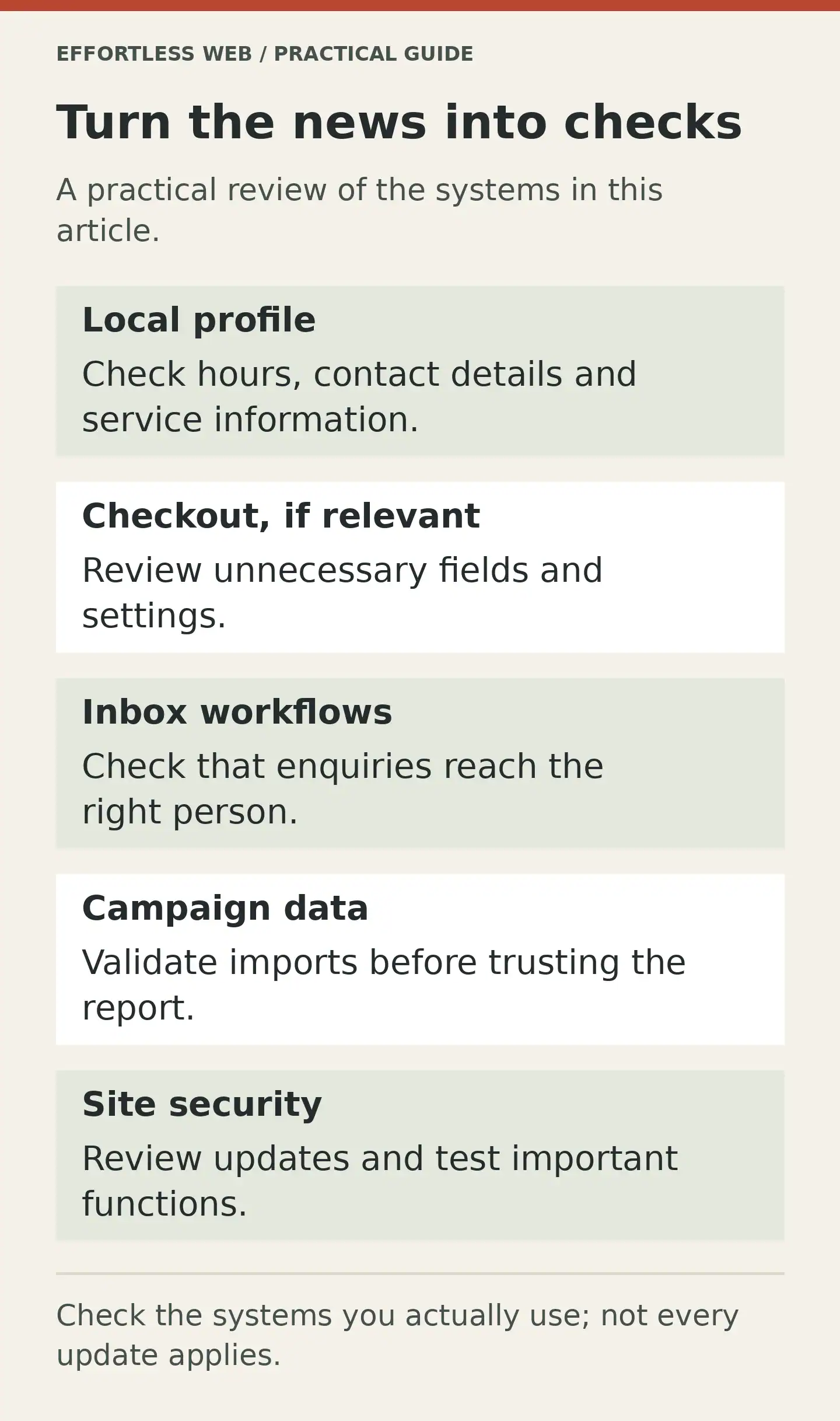
Why it matters: local visibility is not just about ranking. If your profile is thin, stale or suspended, you can lose trust before anyone reaches your website. For service businesses, that means missed calls, weaker map visibility and fewer enquiries from people who were ready to act.
Source: Search Engine Land — Your Google Business Profile needs a business continuity plan and Google Business Profile Help — Edit your Business Profile
2. Shopify is still tightening checkout decisions
Shopify’s latest changelog includes recommended changes to checkout field settings for eligible stores. That may sound small, but checkout fields are one of the easiest places for friction to build up. A few unnecessary fields or a poorly thought-out setting can create drag right where the customer is ready to buy.
Why it matters: checkout performance is conversion performance. If the platform is pointing out better settings, it is worth taking the hint. Cleaner checkout rules usually mean fewer abandoned carts, fewer customer complaints and fewer surprises for the team behind the store.
Source: Shopify Changelog — Recommended changes to checkout field settings are now available
3. Google Workspace is making Gmail workflows easier to automate
Google Workspace Updates published a September 2 update about new steps in Workspace Studio for Drive, Gmail and Google Chat. In plain English, that gives teams more ways to automate repetitive tasks across the tools they already use every day.
Why it matters: inbox work is rarely just inbox work. For many businesses it is lead handling, follow-up, support and handoff. When Gmail tasks can be automated more cleanly, teams waste less time on manual admin and are less likely to let a good enquiry go cold.
4. Google Analytics still depends on clean inputs
Google Analytics’ validation report for campaign data imports is another reminder that measurement only works when the data is clean. If imports are wrong, incomplete or inconsistent, the reporting layer starts telling a story that does not match reality.
Why it matters: bad data leads to bad decisions. If campaign tags, imports or conversion settings are messy, you can end up cutting the wrong channel or praising the wrong one. A small check now saves a lot of guesswork later.
Source: Google Analytics Help — What’s new in Google Analytics
5. WordPress security is still a live business issue
WordPress 7.0.4 is a security release, which is enough reason for site owners to treat it as a priority rather than background noise. If your site runs on WordPress, the update cycle is part of keeping the business reliable, not just keeping the dashboard tidy.
Why it matters: the site can look fine on the front end while still sitting behind on a release that matters. Regular updates help protect forms, plugins, customer trust and the boring but essential mechanics that keep the site working.
Source: WordPress News — WordPress 7.0.4 Release
What business owners should do next
The commercial takeaway is simple: keep the systems that shape discovery, conversion and trust under control.
If local visibility is the main issue, start with Local SEO. If tracking or reporting is the pain point, Website Optimization & Analytics is the right place to look. And if the site needs a maintenance check, Website Maintenance & Support covers the boring but important work that keeps it reliable.
For a related read, see Why Is Your Website Losing You Leads? 7 Problems to Fix First.
If this week’s changes have made your setup feel harder to manage than it should be, get in touch with Effortless Web.
Sources used
- Search Engine Land — Your Google Business Profile needs a business continuity plan
- Google Business Profile Help — Edit your Business Profile
- Shopify Changelog — Recommended changes to checkout field settings are now available
- Google Workspace Updates — Automate Drive, Gmail, and Google Chat actions with new steps in Workspace Studio
- Google Analytics Help — What’s new in Google Analytics
- WordPress News — WordPress 7.0.4 Release