News & insights
This Week in Digital: Search, Checkout and Security Updates for Business Owners
This Week in Digital: Search, Checkout and Security Updates for Business Owners
This week’s pattern is pretty clear: the platforms that shape discovery, conversion and trust are adding more automation, more rules, and more reporting. That can be helpful, but only if the business keeps its basics tight.
Google is pushing Search and Maps further toward AI-assisted actions, Shopify is tightening checkout logic while expanding analytics views, Google Analytics is changing how consent is controlled, and WordPress is still moving fast under the hood. In other words: the web is not standing still, and neither is the job of keeping a site commercially useful.
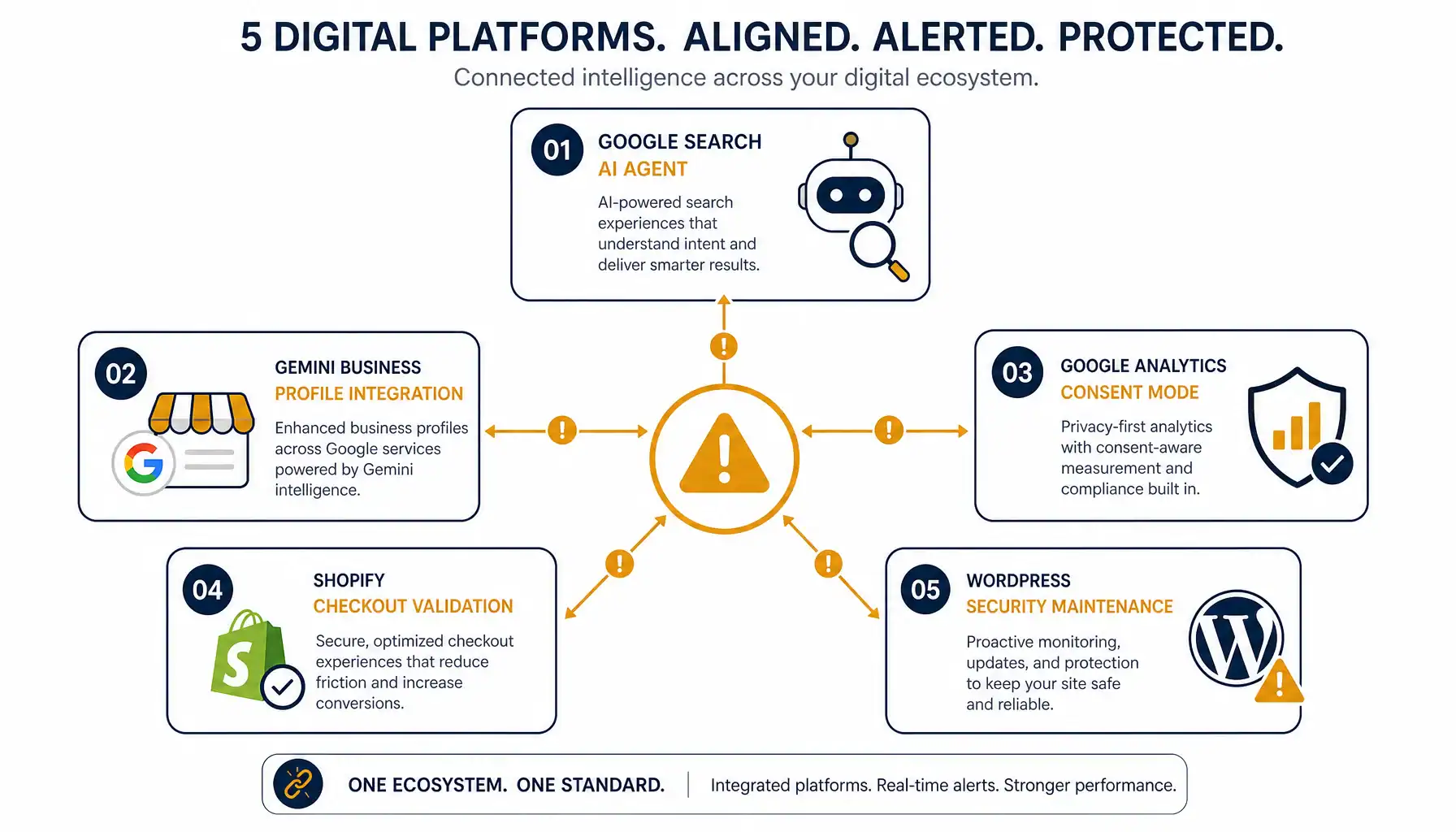
1. Google Search is getting more agentic, especially for local tasks
Google’s I/O 2026 Search update says Search agents can now tap into fresh, real-time sources such as reviews, live maps and local data to help people stay on track with tasks over time. Google also says the experience is expanding into more complex actions, including local experiences and services.
Why it matters: This is another sign that local discovery is moving away from simple keyword matching and toward answer-and-action flows. If your business depends on local visibility, your Google Business Profile, service pages and availability signals need to be accurate, specific and easy for both people and AI systems to understand.
Source: Google Blog — Google Search’s I/O 2026 updates: AI agents and more
2. Google is tying Business Profile more closely to Gemini
Google’s June 10 small-business Gemini update says users will soon be able to connect Google Business Profile to Gemini. Google says Gemini can then use real-world context such as customer reviews, customer questions and performance data to act more like a business assistant.
Why it matters: Business data is becoming part of how AI tools understand a company. If your profile is stale, inconsistent or thin, you are giving the machine less useful context. If it is current and well maintained, you give Google’s ecosystem a cleaner signal about what your business actually does.
Source: Google Blog — New Gemini app features for small businesses
3. Google Analytics is changing its consent control setup
Google says that from June 15, 2026, Google Analytics will use Consent Mode in Google Ads as the single control for data collection and use. The Google Signals setting will no longer act as a separate control point for ads data.
Why it matters: If your consent setup, remarketing setup or reporting logic has grown over time without a review, this is the kind of change that can create confusion later. A quick audit of banners, tags and Ads-to-Analytics connections is cheaper than trying to untangle inconsistent data after the fact.
Source: Google Analytics Help — Updates to Google Analytics Data Controls
4. Shopify is adding more control at checkout and more useful analytics views
Shopify’s June 17 changelog added address-format validation in Checkout Blocks, which lets merchants block non-compliant shipping addresses before they become fulfilment problems. Shopify also rolled out bubble and sunburst charts in Analytics, giving merchants more ways to spot patterns and compare dimensions visually.
Why it matters: Checkout errors are expensive because they create friction at the point of conversion, while weak reporting makes it harder to see what is actually happening in the store. Together, these updates push merchants toward cleaner operations and better decision-making.
Sources: Shopify Changelog — Checkout Blocks: Prevent non-compliant shipping addresses at checkout and Shopify Changelog — Bubble and sunburst charts in Analytics
5. WordPress maintenance and scam pressure both remain live issues
The WordPress Developer Blog’s June update says wp-now is being deprecated in favour of Playground CLI, while PR previews, PHP snippets and saved Playgrounds continue to mature. Separately, Google’s June frauds and scams advisory highlights ongoing phishing and scam tactics, including work around Device Bound Session Credentials to reduce cookie theft.
Why it matters: The practical takeaway is simple: the web stack keeps changing, and the security threat surface is not getting smaller. If your site runs on WordPress, ongoing maintenance is not optional. If your business relies on customer trust, scam resilience and update discipline are part of the same commercial job.
Sources: WordPress Developer Blog — What’s new for developers? (June 2026) and Google Blog — Google’s June 2026 frauds and scams advisory
What this means for business owners
If your search visibility needs attention, SEO & Content Marketing and Local SEO are relevant. For WordPress security and ongoing site reliability, Website Maintenance & Support covers updates and monitoring.
The common thread this week is control: control over what customers see, control over how checkout behaves, control over what your data means, and control over whether your site stays reliable.
That is not a bad thing. It is just a reminder that a useful website now needs active management, not passive ownership. If your search presence, analytics, checkout flow or WordPress setup is starting to feel harder to manage than it should, that is usually the sign it is time for a proper review.
If you want the deeper version of the search-and-AI shift, see Big news this week: Google’s AI push, zero-click search and what it means for your website.
Need help making sense of the changes?
If you want a practical review of your website, local visibility, analytics or conversion setup, get in touch with Effortless Web.
Sources used
- Google Blog — Google Search’s I/O 2026 updates: AI agents and more
- Google Blog — New Gemini app features for small businesses
- Google Analytics Help — Updates to Google Analytics Data Controls
- Shopify Changelog — Checkout Blocks: Prevent non-compliant shipping addresses at checkout
- Shopify Changelog — Bubble and sunburst charts in Analytics
- WordPress Developer Blog — What’s new for developers? (June 2026)
- Google Blog — Google’s June 2026 frauds and scams advisory