News & insights
What Google Actually Wants From Helpful Service-Business Content

What Google Actually Wants From Helpful Service-Business Content
Helpful service-business content is not the same thing as long content, and it is definitely not the same thing as content that tries very hard to sound impressive. Google wants pages that help a real person understand the topic, trust the business and take the next step.
That sounds simple, but a lot of service pages still miss the mark. They either stay too vague, lean too hard on jargon, or read like they were written to satisfy a checklist instead of a customer.
If the content is genuinely useful, that is usually the better route. Search engines are built to reward pages that people can use. Customers are even less patient than that.
Helpful service-business content starts with one job
Every page should do one main thing. A service page should explain the service. A blog post should answer the question. A location page should explain why the business serves that place.
Once the job is clear, the writing gets easier to control. The page stops drifting. The headings stay on topic. The copy feels more confident because it is trying to do one useful thing instead of five half-finished ones.
Google’s people-first content guidance is a good place to start if you want the official version. The SEO Starter Guide points in the same direction: make the page useful, understandable and easy to crawl.
That is the baseline. It is not fancy, but it works.
What makes content genuinely helpful
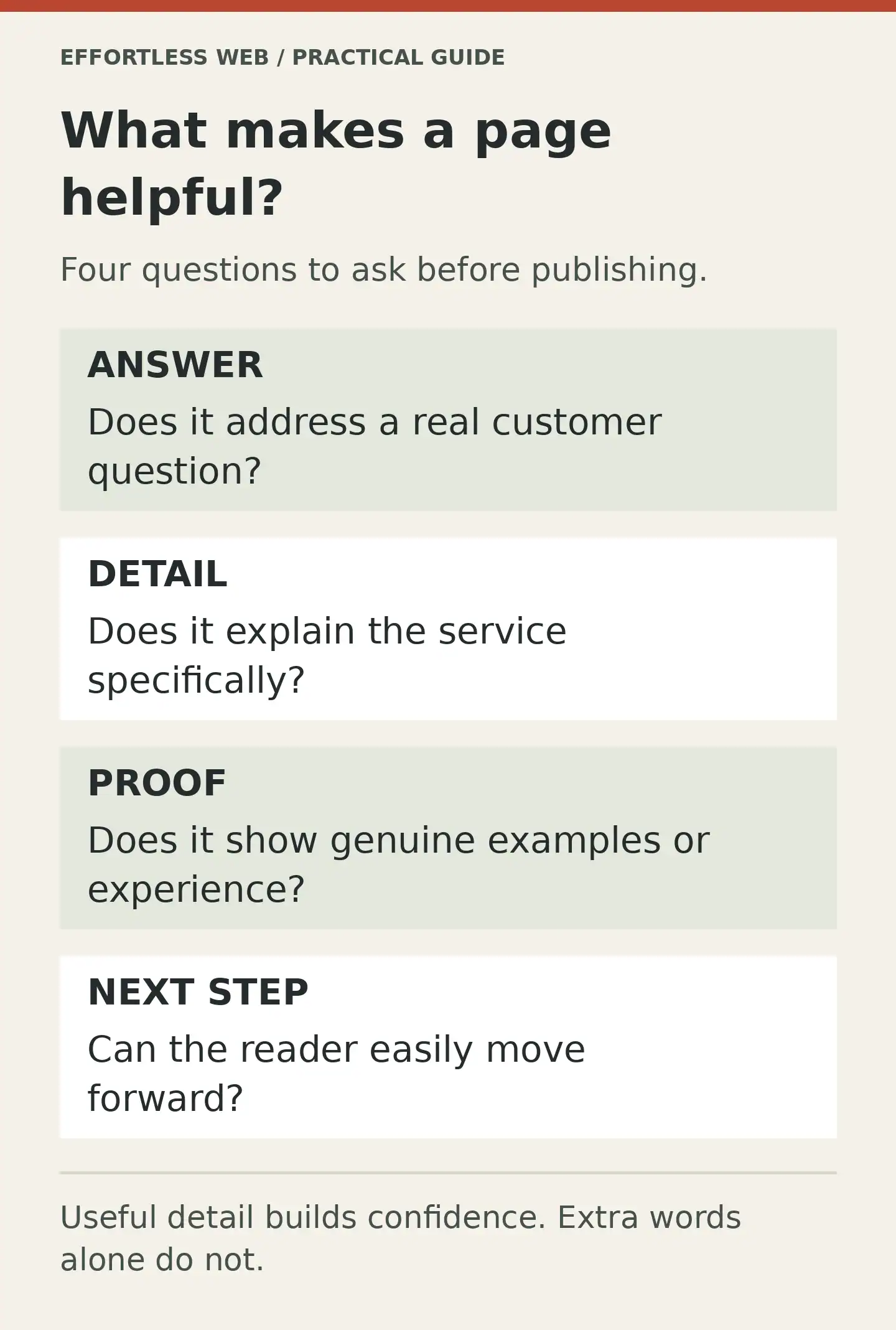
Helpful content usually has four things in common.
- It answers a real question. The reader should know very quickly what the page is for.
- It is specific. Generic statements are easy to ignore and harder to trust.
- It uses proof. Examples, process notes, testimonials and plain language help the reader believe it.
- It gives a next step. The page should not leave people hanging after the useful part.
That is true for service pages, and it is true for article content too. People do not just want information. They want enough confidence to move forward.
A helpful page usually feels calm. It does not overpromise. It does not make every sentence sound like a campaign slogan. It simply does the job.
What Google does not want
This is where a lot of content goes wrong.
Google does not want pages that exist only to catch search traffic and funnel people somewhere else. It does not want thin pages that repeat the same line in a dozen slightly different ways. It does not want doorway pages, spin-off pages or content that looks useful until you actually try to use it.
The spam policies for Google web search are useful here because they show the line between legitimate content and content that is clearly built to manipulate rather than help.
That line matters more now. As search gets more summarised and more competitive, weak content becomes easier to ignore.
If a page would feel empty once you removed the keyword, it probably needs more work.
What helpful content looks like for a service business
Service businesses need content that does more than explain a topic. The content has to help someone choose a provider.
That usually means the page should do a few practical things:
- say who the service is for
- say what problem it solves
- say how the process works
- show evidence that the business can do the work
- make the next step easy
For example, a page about SEO should not just explain SEO. It should explain how that service helps a real business get found, get trust, and get enquiries. A page about Content Writing should not just describe writing. It should show how the writing supports leads, sales and search visibility.
That is why content and commercial intent should stay connected. A page can be informative and still be written with a business outcome in mind.
Proof matters more than polish
A polished page with no proof is still a weak page.
People are quick to notice when content sounds generic. They are even quicker to notice when a page makes claims without showing any evidence. Specifics help. So do examples. So does a clear explanation of what the business actually does.
That might mean before-and-after examples, process steps, common mistakes, client questions, or small details that show the business has real experience. It does not have to be dramatic. It just has to be real.
This is also where good content feels more trustworthy than clever content. Trust is usually built by clarity, not flair.
How to make the content stronger
If you want a page to do better, start with the boring basics.
Make the H1 clear. Use headings that match the reader’s questions. Keep the opening paragraph direct. Put the most important answer near the top. Then add only the detail that actually helps the reader decide.
Internal links matter too. For Effortless Web, helpful service-business content should usually connect to SEO & Content Marketing, Content Writing and On-Page & Technical SEO. Those links make the page easier to place inside the wider site structure.
A strong companion read here is Content Writing for SEO: How to Sound Human and Still Rank. That article gets into the writing side in more detail.
That is usually enough. You do not need ten links. You need the right ones.
A quick test before you publish
Try this before a page goes live:
- Would a real customer get value from this page in under a minute?
- Does the first paragraph tell them where they are and why they should care?
- Is the page specific enough to trust?
- Does it sound like a business with actual experience?
- Does it give the reader a clear next step?
- Would you be happy to send a prospect to this page?
If the answer is mostly yes, you are probably in the right area. If the answer is mostly no, the page may need more detail, better structure or a clearer point of view.
The real goal is usefulness
That is the part that gets lost when people talk about SEO as if it were a bag of tricks. The content that tends to win is usually the content that is easiest to understand and easiest to trust.
Helpful service-business content is not about stuffing pages with keywords. It is about making the business easier to choose. Search visibility is one result of that. Better enquiries are another.
So if you are deciding what to improve first, start with the pages that are supposed to help someone say yes.
Need help turning service-business content into something more useful?
If you want pages that are clearer, more trustworthy and better aligned with search intent, talk to Effortless Web about SEO & Content Marketing, Content Writing or get in touch.